
PHE Base Skids
What is a PHE Skid?
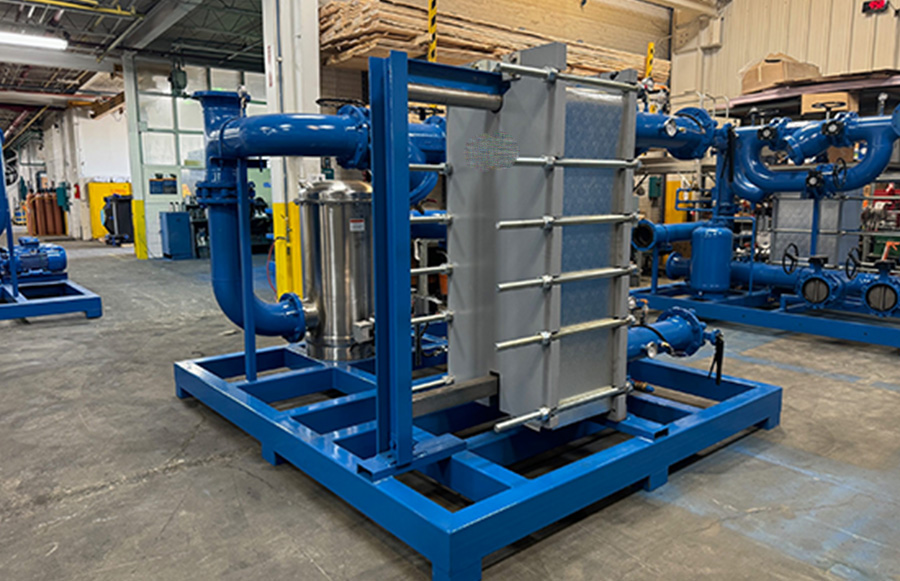
A PHE skid is a complete, pre-engineered heat transfer package built around a plate heat exchanger. The PHE, pumps, valves, instruments, and control panel are mounted on a common structural base frame, fully piped, wired, and tested in the factory. On site, the skid simply needs connection to utilities and power, and it is ready to run.
Plate heat exchangers deliver 3 to 5 times higher heat transfer than conventional shell-and-tube units, with a much smaller footprint and very close temperature approach. Packaging the PHE as a skid adds reliable control, redundancy, and easy maintenance access, giving a ready-to-use solution for heating, cooling, isolation, and heat recovery duties.
Why Choose a PHE Skid
Compact Footprint
High-efficiency PHE and integrated layout save valuable floor space.
Faster Installation
Pre-piped and pre-wired; only utility connections are needed on site.
Factory Tested
Pressure and function tested before dispatch for reliable start-up.
Precise Control
PLC-based temperature control, typically within ±1–2°C.
Energy Efficient
Close temperature approach of 1–3°C maximises heat transfer and recovery.
Single Responsibility
One supplier for design, fabrication, controls, and performance.
Standard Skid Build
| Element | Typical Scope |
|---|---|
| Heat Exchanger | Gasketed, brazed, semi-welded, or wide-gap PHE; SS 304/316, titanium, or alloy plates; EPDM, NBR, or FKM gaskets. |
| Pumps | Duty/standby centrifugal, gear, or screw pumps with optional VFD and auto changeover. |
| Valves | 2-way/3-way control valves, isolation, non-return, safety relief, drain and vent valves. |
| Filtration | Y-strainers, basket strainers, auto-backwash filters, or duplex oil filters. |
| Instruments | Temperature, pressure, flow, level, and conductivity transmitters, gauges, and switches. |
| Controls | PLC/HMI panel with PID control, alarms, trends, and SCADA/BMS communication. |
| Structure | MS epoxy-painted or SS base frame, drip tray, lifting lugs, insulation as required. |
PHE Skid Solutions
Pre-engineered and factory-tested skid packages designed for reliable heating, cooling, isolation, and heat recovery applications.
01
Hot Water Skid
Controlled hot water from steam, thermal oil, or hot water
Produces hot water at a precise set temperature by transferring heat from steam, thermal oil, or high-temperature water to a secondary water circuit through a PHE. A PLC modulates the heating valve to hold the outlet temperature, while the condensate set returns condensate to the boiler house. It replaces direct steam injection and tank heaters with a compact, safe, and efficient system.
Key Components
- Gasketed or plate-and-shell PHE
- Steam / thermal oil control valve
- Steam trap and condensate set
- Duty/standby circulation pumps
- Expansion vessel and safety valve
- High-temperature cut-off
- PLC/HMI control panel
Typical Specifications
- Outlet: 40–95°C (up to 120–140°C pressurised)
- Steam supply: up to 10 bar(g)
- Control accuracy: ±1–2°C
- Capacity: 50 kW to several MW
Applications: CIP systems, parts washers, paint pre-treatment baths, reactor jacket heating, digester feed heating, textile process water, and building hot water.
Benefits: Precise temperature, no steam contamination of water, full condensate recovery, and safer operation than open steam injection.
Design Note: Correct control valve sizing and free-draining condensate are essential for stable control and to avoid water hammer.
02
Oil Cooling Skid
Stable oil temperature for longer equipment and oil life
Cools hydraulic, lubricating, quench, gearbox, compressor, or transformer oil using cooling or chilled water through a PHE fitted with oil-resistant gaskets. Oil is filtered before the PHE, and a temperature control valve holds the set temperature. The oil side is kept at higher pressure than the water side so that any leak cannot contaminate the oil with water.
Key Components
- Gasketed PHE with NBR / FKM gaskets
- Gear, screw, or centrifugal oil pump
- Duplex oil filter with ΔP indicator
- 2-way / 3-way temperature control valve
- Oil pressure relief valve
- Level and temperature switches
- Drip tray and control panel
Typical Specifications
- Oil inlet: 50–90°C
- Oil outlet: 40–60°C
- Cooling water: 30–32°C tower or 7–15°C chilled
- Control accuracy: ±1–2°C (±0.5°C precision)
Applications: Hydraulic presses, die casting and injection moulding machines, forging presses, heat treatment quench tanks, grinding and honing, turbine lube oil, gearboxes, and compressors.
Benefits: Longer oil and seal life, stable machine performance, fewer breakdowns, and a far smaller footprint than shell-and-tube oil coolers.
Design Note: Plate selection must account for oil viscosity, especially at cold start.
03
Cooling Tower Water Isolation Skid
Clean closed process loop, protected from cooling tower water
Separates the open cooling tower or raw water circuit from a clean, treated closed process water loop. Process water collects heat from machines and rejects it to tower water through the PHE, without the two streams ever mixing. Machines receive only clean water, preventing scaling and blockage of their cooling passages.
Key Components
- Gasketed PHE (2 × 100% or 2 × 60%)
- Duty/standby process water pumps
- Auto-backwash or basket strainer (tower side)
- Control valve or VFD control
- Expansion tank and auto make-up
- Chemical dosing pot
- Flow, temperature, and pressure monitoring
Typical Specifications
- Temperature approach: 1–3°C
- Process supply: typically 30–35°C
- Closed loop pressure: 3–6 bar(g)
- Plates: SS 316 or titanium for chlorides
Applications: Plant-wide machine cooling in automotive component, plastics, and rubber plants, welding lines, compressors, power plant auxiliaries, chiller isolation, and data centre free cooling.
Benefits: Prevents scaling in machines, reduces maintenance and downtime, lowers water treatment cost, and enables free cooling in cool weather.
Design Note: Standby PHE capacity allows cleaning without plant shutdown.
04
Heat Recovery Skid
Turn waste heat into useful energy
Captures heat from hot waste streams such as effluent, condensate, compressor oil, engine jacket water, or spent wash, and transfers it to water or process fluid that needs heating. The PHE's close temperature approach recovers far more heat than conventional exchangers, while bypass controls ensure the source process is never disturbed.
Key Components
- Gasketed or wide-gap PHE
- Source and receiving side pumps
- 3-way diverting / bypass valve
- Filters or self-cleaning strainers
- Buffer tank (optional)
- BTU / energy meter
- PLC/HMI control
Typical Specifications
- Approach temperature: 2–5°C
- Typical saving: 10 m³/h effluent, 60→30°C ≈ 348 kW
- Equivalent to ≈ 600 kg/h steam
- Typical payback: 1–2 years
Applications: Compressor heat recovery, washer and dye house effluent, condensate recovery in sugar mills, distillery wash preheating, grain mash-to-mash recovery, pasteurizer regeneration, and CBG digestate.
Benefits: Lower steam and fuel consumption, reduced carbon emissions, reduced cooling load, and fast payback.
Design Note: Wide-gap plates and good filtration are recommended for dirty or fibrous waste streams.
05
DM Water Cooling Skid
Low-conductivity cooling for electrically live equipment
Provides a closed loop of high-purity demineralized water for cooling induction coils, power electronics, lasers, and electrolysers, where ordinary water would cause scaling and electrical leakage. The DM loop is cooled by tower water through an SS 316 PHE, while a side-stream polisher keeps conductivity low and continuous monitoring protects the equipment.
Key Components
- SS 316 PHE with EPDM gaskets
- SS 304/316 DM water tank
- Duty/standby SS pumps, auto changeover
- Mixed-bed polisher (side-stream)
- Conductivity meter with alarm
- Flow switches per circuit
- Emergency backup cooling and PLC interlocks
Typical Specifications
- Conductivity: typically below 10–20 µS/cm
- Supply temperature: 25–35°C
- Pressure: 3–6 bar(g)
- All wetted parts: stainless steel / non-metallic
Applications: Induction melting furnaces and billet heaters, induction hardening, laser welding and cutting, electrolysers, rectifiers, electric arc furnace components, and spot welding transformers.
Benefits: Protects costly coils and electronics, prevents scaling and corrosion, improves uptime, and reduces maintenance.
Design Note: Keep supply temperature above dew point to prevent condensation on live parts.
06
Single Fluid Heating & Cooling System
One welded PHE heats, holds and cools the same circuit
Holds a process at any point across a wide temperature range using one circulating fluid and one exchanger. A single fully welded plate heat exchanger takes steam on the utility side when the batch needs heating and cooling water when it needs cooling, with control valves blending between the two. The welded pack withstands the steam temperature and thermal cycling that would destroy an elastomer seal.
Key Components
- Single fully welded plate heat exchanger
- Steam and cooling water control valves
- Circulation pump, single or duty / standby
- Expansion and buffer vessel
- Condensate set and drain trap
- PT100 sensors on jacket and product
- Cascade PID control with recipe ramps
Typical Specifications
- Range: -20 °C to 200 °C (fluid dependent)
- Control accuracy: ±0.5 to ±1 °C
- Circulation flow: 5 to 50 m³/h
- Exchanger: welded plate pack, no gaskets
Applications: Reactor and vessel jackets in chemical and pharmaceutical plants, autoclaves, crystallisers, mould temperature control, resin processing, pilot plants and R&D skids.
Benefits: One fluid and one exchanger for the whole cycle, no changeover between heating and cooling, no gaskets to replace, and far less piping than separate hot and cold systems.
Design Note: The welded pack removes the gasket limit on temperature, but it is cleaned chemically rather than opened, so utility-side filtration matters.
Skid Comparison at a Glance
| Skid | Primary Side | Secondary Side | Main Purpose | Key Feature |
|---|---|---|---|---|
| Hot Water | Steam / thermal oil / hot water | Process water | Controlled hot water supply | Steam control valve, condensate handling |
| Oil Cooling | Hot oil | Cooling / chilled water | Oil temperature control | Oil at higher pressure, NBR/FKM gaskets |
| Cooling Water Isolation | Closed process water | Cooling tower water | Protect machines from dirty water | Tower-side strainer, redundancy |
| Heat Recovery | Hot waste stream | Stream needing heat | Energy saving | Bypass protection, wide-gap plates |
| DM Water Cooling | DM water (closed) | Cooling tower water | Cool electrically live equipment | Conductivity control, all-SS wetted parts |
| Single Fluid Heating & Cooling System | Thermal fluid | Process equipment | Controlled heating and cooling | Single-loop circulation, precise temperature control |
Industries Served
| Industry | Hot Water | Oil Cooling | CW Isolation | Heat Recovery | DM Water |
|---|---|---|---|---|---|
| Automotive & Auto Parts | ✓ | ✓ | ✓ | ✓ | ✓ |
| Foundry & Forging | ✓ | ✓ | ✓ | ✓ | |
| Food, Dairy & Beverage | ✓ | ✓ | ✓ | ||
| Pharmaceutical | ✓ | ✓ | ✓ | ||
| Chemical & Petrochemical | ✓ | ✓ | ✓ | ✓ | |
| Power Generation | ✓ | ✓ | ✓ | ✓ | |
| Sugar, Ethanol & Distillery | ✓ | ✓ | ✓ | ✓ | |
| CBG & Biogas | ✓ | ✓ | ✓ | ✓ | |
| Plastics & Rubber | ✓ | ✓ | ✓ | ✓ | |
| Steel & Metals | ✓ | ✓ | ✓ | ✓ | |
| Textile | ✓ | ✓ | |||
| HVAC & Data Centres | ✓ | ✓ | ✓ | ||
| Hydrogen & Electronics | ✓ | ✓ |
Material Selection Guide
| Item | Option | Best Suited For |
|---|---|---|
| Plates | SS 304 | Clean water, HVAC, closed loops |
| Plates | SS 316 / 316L | Process water, emulsions, food, pharma, DM water |
| Plates | Titanium | Seawater, high-chloride water, plating and anodizing baths |
| Plates | Hastelloy / Nickel / Alloys | Acids and aggressive chemicals |
| Gaskets | EPDM | Water, glycol, steam, DM water, ethanol, alkaline CIP |
| Gaskets | NBR | Mineral oils, hydraulic oil, quench oil |
| Gaskets | FKM (Viton) | High temperature, synthetic oils, aggressive chemicals |
Information Required for Quotation
To size and quote the right skid, please share the following details:
| Parameter | Hot Side | Cold Side |
|---|---|---|
| Fluid name / type | ||
| Flow rate (m³/h or kg/h) | ||
| Inlet temperature (°C) | ||
| Required outlet temperature (°C) | ||
| Operating / design pressure (bar) | ||
| Allowable pressure drop (bar) | ||
| Solids / fibres / special properties |
Also helpful: heat load (kW), available utilities (steam, power supply), redundancy needs, hazardous area classification, control/communication requirements, and site space limits.