
Industrial Plate Heat Exchangers
Plate Heat Exchangers Engineered for Efficiency
Compact, high-performance PHEs designed for your process: heating, cooling, heat recovery, and condensing across every industry.
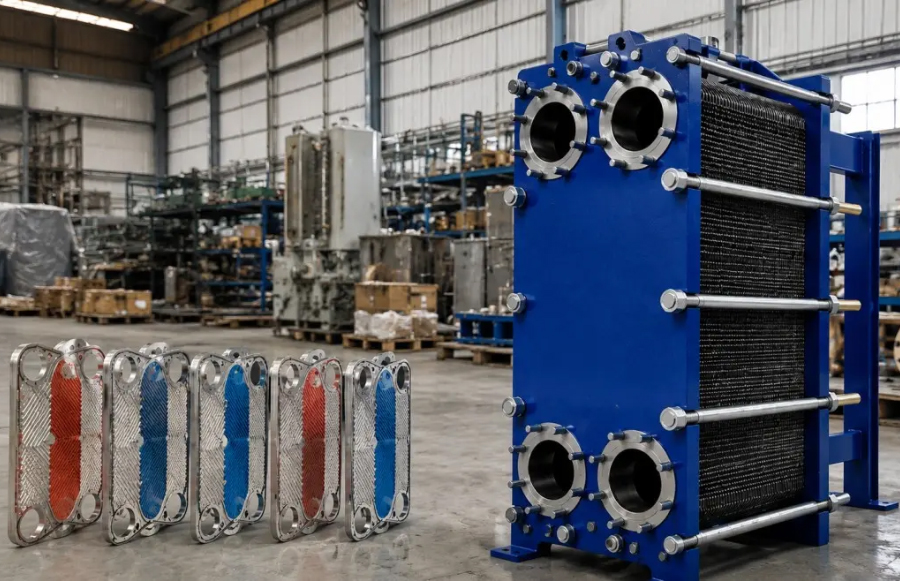
Efficient Heat Transfer in a Compact Design
A plate heat exchanger transfers heat between two fluids through a pack of thin, corrugated metal plates. The corrugations create strong turbulence, giving 3 to 5 times higher heat transfer than conventional shell-and-tube exchangers, in a fraction of the space.
Our plate heat exchangers are thermally designed for your exact duty, built with the right plate and gasket materials for your fluids, and pressure-tested before dispatch, so you get reliable performance, lower energy costs, and easy maintenance for years.
How a Plate Heat Exchanger Works
Hot and cold fluids flow through alternate channels between the plates, usually in counter-current direction. Heat passes through the thin plate wall from the hot fluid to the cold fluid, without the two fluids ever mixing.
Gaskets or welds seal each channel and direct the fluids to the correct ports. The plate pack is clamped between a fixed frame plate and a movable pressure plate with tightening bolts.
Capacity can be increased simply by adding plates, making plate heat exchangers flexible for changing process requirements.
Our Product Range
Choose from a range of plate heat exchanger designs engineered for different fluids, operating conditions, and industrial applications.
01
Gasketed Plate Heat Exchangers
The most versatile PHE, with plates sealed by elastomer gaskets and clamped in a frame. Easy to open, inspect, clean, and expand.
Best for: HVAC, food and dairy, power, marine, chemicals, and general industry
02
Brazed Plate Heat Exchangers
Compact, lightweight units with plates vacuum-brazed together, with no gaskets or frame. Handle high pressure in a very small size.
Best for: Refrigeration, heat pumps, HVAC, domestic hot water, and oil cooling
03
Semi-Welded Plate Heat Exchangers
Plates welded in pairs into cassettes, with gaskets only between cassettes. The aggressive fluid stays in the welded channel.
Best for: Ammonia refrigeration, and aggressive or hazardous fluids on one side
04
Fully Welded Plate Heat Exchangers
No gaskets at all, for high temperature, high pressure, and aggressive chemicals.
Best for: Chemicals, refining, oil and gas, and solvents
05
Wide-Gap (Free-Flow) Plate Heat Exchangers
Wide channels with few contact points, so fibres, particles, and viscous fluids pass without clogging.
Best for: Sugar juice, grain mash, spent wash, pulp and paper, sludge, and effluent heat recovery
Technical Specifications (Typical)
| Parameter | Range |
|---|---|
| Heat transfer area | [e.g. 0.5 m² to 2,000+ m² per unit] |
| Flow rate | [e.g. up to 3,500 m³/h] |
| Design pressure | [e.g. up to 25 bar gasketed, 30+ bar brazed/welded] |
| Design temperature | [e.g. −30°C to 180°C gasketed, higher for welded] |
| Connection sizes | [e.g. DN 25 to DN 500] |
| Connection types | Flanged, studded, threaded, sanitary (tri-clamp) |
| Frame finish | Epoxy-painted carbon steel or stainless steel clad |
Materials of Construction
| Component | Options |
|---|---|
| Plates | SS 304, SS 316/316L, Titanium, SMO 254, Hastelloy, Nickel, and other alloys |
| Gaskets | NBR, HNBR, EPDM, FKM (Viton), food-grade and FDA-compliant grades |
| Gasket fixing | Clip-on (glue-free) or glued |
| Port liners | EPDM, NBR, SS 316, Titanium |
Key Features and Advantages
High Thermal Efficiency
Turbulent flow gives 3 to 5 times higher heat transfer than shell-and-tube units.
Close Temperature Approach
As close as 1°C, for maximum heat recovery.
Compact Size
Up to 80% less floor space than an equivalent shell-and-tube exchanger.
Expandable Capacity
Add plates to increase capacity as your plant grows.
Easy Maintenance
Open the frame to inspect and clean plates on site.
Low Fluid Hold-up
Faster response and better temperature control.
Lower Cost in Special Materials
Thin plates need far less titanium or alloy than tubes.
Lower Fouling
High turbulence reduces deposits and extends cleaning intervals.
PHE vs Shell-and-Tube
| Feature | Plate Heat Exchanger | Shell-and-Tube |
|---|---|---|
| Heat transfer efficiency | Very high | Moderate |
| Footprint | Compact | Large |
| Temperature approach | Down to 1°C | Typically 5°C or more |
| Capacity change | Add or remove plates | Not possible |
| Maintenance | Open frame, clean plates | Tube bundle removal needed |
| Cost in special alloys | Lower | Higher |
| Very high pressure / temperature | Limited (welded types extend range) | Suitable |
Applications
Heating and Cooling
Process fluids, water, oils, and chemicals.
Heat Recovery
Capturing waste heat from effluents, condensate, and hot product.
Condensing and Evaporating
Steam condensers, refrigerant evaporators, and condensers.
Loop Isolation
Separating cooling tower water from clean process loops.
Pasteurization and Sterilization
Dairy, juices, beverages, and pharma.
Design, Manufacturing, and Quality
| Stage | What We Do |
|---|---|
| Thermal Design | Every PHE is sized using thermal design software for your actual flows, temperatures, and fluids. |
| Material Selection | Plates and gaskets chosen for chemical compatibility, temperature, and pressure. |
| Manufacturing | Precision assembly with quality checks at every stage. |
| Testing | Hydrostatic pressure test on every unit before dispatch. |
| Documentation | Datasheet, general arrangement drawing, test certificates, and material certificates. |
| Standards | Applicable standards such as ASME, PED, 3-A, EHEDG, and ISO 9001, as required for the application. |
Complete PHE Solutions
PHE Skids
Ready-to-install packages for hot water, oil cooling, cooling water isolation, heat recovery, and DM water cooling.
PHE Spares
Plates, gaskets, and frame parts for all major brands.
Replacement PHE
Drop-in replacements for old or obsolete units of any brand.
Service
Regasketing, cleaning, crack detection, and reconditioning.
How to Get the Right PHE
01
Share Your Requirement
Share your fluids, flow rates, and temperatures with our engineering team.
02
Thermal Design
Our engineers size the most efficient PHE for your specific duty.
03
Proposal
Receive the technical datasheet, drawing, and commercial proposal.
04
Manufacturing and Testing
Your PHE is built and pressure-tested according to your specification.
05
Delivery and Support
Get commissioning support, spares, and service throughout the PHE lifecycle.
Information Required for a Quote
| Parameter | Hot Side | Cold Side |
|---|---|---|
| Fluid name | ||
| Flow rate (m³/h or kg/h) | ||
| Inlet temperature (°C) | ||
| Outlet temperature (°C) | ||
| Operating pressure (bar) | ||
| Allowable pressure drop (bar) |
Also helpful: heat load (kW), design pressure and temperature, preferred materials, connection type, and space limits.
Frequently Asked Questions
Gasketed PHEs can be opened for cleaning and expanded,
making them ideal for industrial duties. Brazed PHEs are
more compact and handle higher pressure, making them
ideal for refrigeration, HVAC, and clean fluids.
Yes. Additional plates can be added within the frame's
capacity, as long as the frame length allows it.
It depends on the fluids. Clean water duties may need
cleaning only every few years, while dirty or scaling
fluids need more frequent cleaning. Gaskets typically
last 3 to 6 years.
Yes. Our wide-gap (free-flow) PHEs are designed for
fibrous, viscous, and particle-laden fluids.
Yes. Welded and semi-welded PHEs extend the operating
range beyond gasketed designs. Share your conditions
and we will recommend the right type.
Get a PHE Designed for Your Exact Process
Share your requirements and receive a thermal design and quotation from our engineers.
Industrial Plate Heat Exchangers
Industrial Plate Heat Exchangers (PHEs) are high-efficiency thermal equipment used for transferring heat between two fluids without direct mixing. Their compact design and large heat transfer surface make them suitable for a wide range of industrial heating, cooling, heat recovery, and temperature control applications.
Degree Kelvin Solutions offers technically suitable PHE solutions based on the customer's process conditions and operating requirements. Our solutions can be considered for process industries, OEMs, EPC projects, utilities, and plant maintenance applications, including both new installations and replacement requirements.
Key Features
- High Heat Transfer Efficiency – Provides effective heat transfer with a compact plate arrangement.
- Compact Design – Requires less installation space compared to conventional heat exchangers.
- Flexible Configuration – Can be configured according to flow, temperature, and process requirements.
- Easy Maintenance – Designed for convenient inspection, cleaning, and servicing.
- Reliable Performance – Supports consistent thermal performance for continuous industrial operation.
- Wide Operating Range – Suitable for different heating, cooling, and heat recovery requirements.
Applications
- Process Heating & Cooling – Maintains required process temperatures efficiently.
- HVAC Systems – Used for heating and cooling water in HVAC applications.
- Heat Recovery – Recovers useful heat from hot process fluids to improve energy efficiency.
- Food & Beverage – Supports controlled heating and cooling in various processing operations.
- Chemical Industries – Used for process temperature control and fluid cooling.
- Pharmaceutical Industries – Suitable for controlled thermal processes and utility systems.
- Oil & Water Cooling – Provides efficient cooling for industrial fluids and equipment.
- Utility Systems – Used in hot water, chilled water, and other industrial utility applications.